What wedding catering costs in Mallorca
These are our prices for a wedding in Mallorca: what a day costs per person, what that covers, what it does not, and what makes one wedding cost more than another.
Our prices
Family-style and plated dinners are priced the same. For 2027–2028, with set-up and breakdown on the day itself, the price per person is:
| Guests | Price per person |
|---|---|
| 60 | €300 |
| 80 | €270 |
| 100 | €250 |
| 120 | €245 |
| 140 | €235 |
| 200 | €225 |
Most weddings we cater are between sixty and a hundred and twenty guests, which is where this pricing sits most comfortably. All prices include 10% VAT. These are the prices for a standard wedding; bespoke weddings are priced individually, and there is more on that below.
The price per head falls as numbers rise because much of the cost of an event is fixed. The kitchen has to be built, the equipment transported and the team briefed whether you invite sixty guests or two hundred. Spread over more people, each plate carries less of it.
What that price includes
The per-head figure is not a food price. It covers the whole operation, from the first meeting to the last guest leaving.
Before the day: menu planning, two tastings, technical visits to your venue, one-to-one calls throughout the booking, and visits to our furniture suppliers’ showrooms so you can choose in person.
The two tastings are where the menu is actually made. The first is a conversation as much as a meal: what you like, how you want the day to eat, what you would rather never see on the table. The second brings back a menu built around that, and we change it there and then if it is not right. Nothing is chosen off a set list, and no two weddings we cook are the same.
The technical visits matter for a different reason. We go to the venue and work out where a kitchen can go, what power and water are there, and how far a plate has to travel to reach the table, before anything is promised rather than after. The one-to-one calls run through the whole booking, so there is always a person to ask rather than a form to fill in.
Food and drink: all food and ingredients, canapés at the reception, full dinner service, selected wines, beers, soft drinks and water, and a four-hour open bar with premium spirits and cocktails. For dinner, you can choose from our wine list or provide your own.
The people: chefs, waiting staff, bartenders and a dedicated event manager.
The equipment: crockery, cutlery and glassware, tablecloths and napkins, tables, chairs and basic table settings, and all bar and service equipment, including ice.
The logistics: transport of every piece of equipment and every member of staff, full set-up before the event, and complete breakdown and removal afterwards.
What it does not include
Your catering is one line in a wedding budget, not the whole of it. The venue, flowers, music, lighting and photography are all separate. Within catering, extras such as a late-night snack from the van, a coffee service, an espresso martini station or a cava tower are quoted separately, as are bespoke furniture and premium upgrades.
When a wedding costs more
The prices above assume a standard format: a reception, a dinner and a bar, set up and cleared on the day. Bespoke weddings are priced individually, and some choices add cost for reasons that are not always obvious.
Food stations. Paella cooked in front of the guests, a grill, a raw bar, a late-night taco station. Each one is, in effect, a second small kitchen, with its own equipment, its own power and its own chefs for as long as it runs. They are one of the main reasons a quote rises.
Extra days. When a venue cannot be set in a single morning, whether that is a large marquee, an elaborate table design or a site with difficult access, set-up starts the day before. When breakdown cannot happen the same night, it moves to the next day. That means more days of staff, transport and equipment hire, and equipment committed to your wedding cannot be used elsewhere.
Irregular hours. A sunset ceremony, a dinner that runs past midnight, a brunch the next morning. Longer days mean more staff hours.
The venue itself. Some of the biggest variables are set by the venue, not by us.
Venues and their restrictions
Every venue sets its own rules, and they shape both the logistics and the price. They can include:
- Finish times: a curfew on music or on the event itself sets when service ends and breakdown can begin.
- Access: narrow tracks, weight limits or a single gate can mean smaller vehicles and more trips.
- Set-up windows: some venues only let suppliers in from a certain hour, which compresses set-up or pushes it to the day before.
- Kitchen and power: whether there is a kitchen at all, and whether additional power has to be brought in.
- Fire risk: in summer, some venues restrict barbecues, open-fire cooking or candles.
- Waste and cleaning: what has to be removed, and the condition the venue expects back.
- Approved suppliers: some venues work only with caterers on their list, or charge a fee to those who are not.
We work regularly at many of the island’s venues and already know their rules. For one that is new to us, we go and see it before we quote.
Where a venue’s rules add cost, you hear it from us as soon as we know, with what it means and what it will add. We would rather have an awkward conversation in February than hand you a number you were not expecting in July. Nothing on a bill from us should ever be a surprise.
Why quotes vary so much
If you are comparing caterers you will see very different numbers, and usually that is because they are not pricing the same thing. It is worth asking each one:
- Does the price include VAT?
- Are staff included, and how many?
- Is tableware, glassware and linen included, or hired separately?
- Is the bar included, for how long, and with which drinks?
- How many days of set-up and breakdown does the quote assume?
- Are food stations included, or priced separately?
- Who clears away at the end of the night?
A quote that looks €60 cheaper per head can cost more once those lines are added back.
What goes into one wedding day
From the outside, a wedding dinner looks like food arriving at tables. Behind it is an operation that begins months earlier.
Most fincas have no working kitchen, so we build one: equipment, refrigeration, power and water, positioned so food reaches the table as it should. Furniture arrives from the rental supplier and is laid out. The van is loaded the day before. On the day, the team arrives hours ahead of the first guest, and every service starts with a briefing, so everyone knows what they are doing, where they stand and who to go to.
As a rough guide, we staff at one person for every ten to fifteen guests. That figure covers everyone: chefs, waiting staff, the bar, logistics and set-up, and the office behind them, so a wedding of 120 guests involves a team of around eight to twelve people. Around us work the venue’s own staff, the florist, the DJ and lighting technicians and the photographer, all running to the same timetable. Dinner is served table by table together, so no one waits while another table eats, and the timing has to move with speeches that run over and weather that changes.
When the last guest leaves, the day is not finished. Everything that arrived has to leave, and the venue has to be handed back as we found it.
Where the money goes
Most of your budget goes to two things: what your guests eat, drink and sit down to, and the people who serve it.
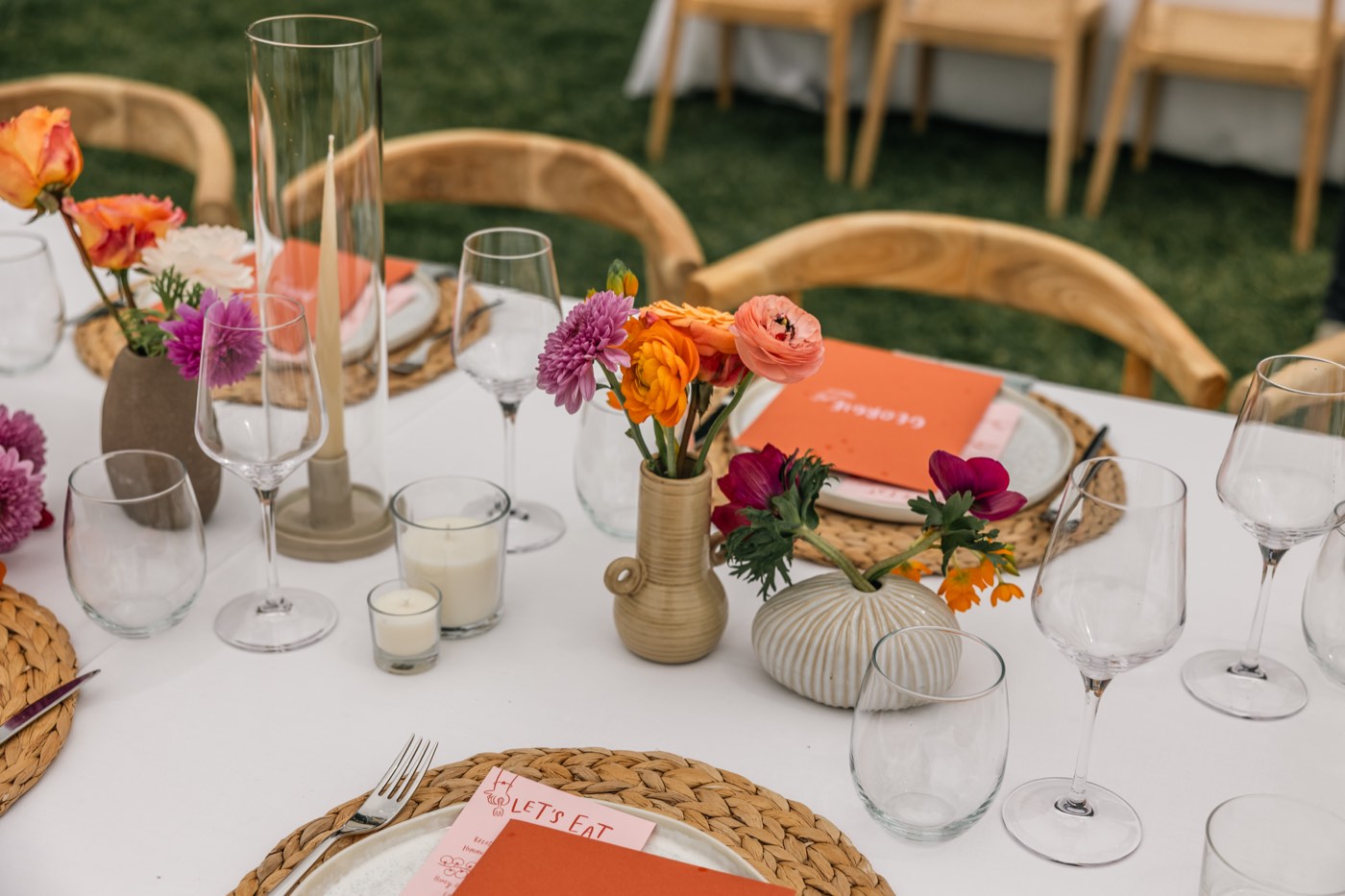
The table. The atmosphere we aim for is relaxed: long tables, food brought out to share, a room that never feels stiff. Relaxed is a style rather than a saving, though, and we would rather put the budget into what guests actually notice than into things that only look impressive on paper.
That starts with the produce: we buy from Mallorcan growers, fishermen and suppliers, and cook with what is in season. It carries through to everything guests touch and pour, from good wine glasses and proper linen to local and national wines and premium spirits at the bar such as Grey Goose, Bombay Sapphire and Don Julio. It is where we think the budget does the most work.
The people. For us, sustainability starts with people. An event should give everyone who works on it the income they need to support themselves and to grow, not only the business whose name is on the invoice.
It is worth being clear about what that work involves. A large wedding is hard, physical labour: loading and unloading, building a kitchen in a field, carrying plates across uneven ground, long days on your feet, much of it in the intense heat of a Mallorcan summer, and a breakdown that often runs past midnight. Guests having the time of their lives depends on it.
Much of the event industry relies on casual labour hired for the day. We pay our team properly for the work, and some of them have been with us three and four years now, which in seasonal work is unusual. It shows in a service that runs calmly: people who have worked together for several seasons do not need to be told what comes next.
A wedding here should leave something behind for the people who make it happen: the venue, the florist, the grower, the team in the kitchen and on the floor. Paying them properly is part of what your price per head buys.
Getting a quote
Tell us your date, your venue and a rough guest number, and we will come back with menus and a price, not an automated reply. You can use the form below, or book a one-to-one call.